Tuesday, March 5, 2013

Lycoposerramine-S


Lycoposerramine-S

Angew. Chem. Int. Ed. 2012, 51, 11824

TN. Shimada, Y. Abe, S. Yokoshima, T. Fukuyama*

The retrosyntheses of Lycoposerramine S beings with the deprotection of the Boc group, N-methylation (para-formaldehyde and sodium cyanoborohydride) and deprotection of the nosyl (4-nitrobenzenesulfonamide) group from 13.  Compound 13 was prepared from 12 by bis-mesylating the bis-alcohol and then treating it with 4-nitrobenzulfonamide using Cs2CO3 as the base.  This is the first time I saw the use of 4-nitrobenzenesulfonamide to install the nosyl group.  Compound 12 was prepared from hydroxyalkene 11 by first activating the hydroxyl group as thionocarbonate and then cyclizing it under free-radical-conditions to the alkene group.  Alkene 11 was prepared by dehydrating the secondary alcohol in 10.  Compound 10 was prepared by the reduction of the ketone group and reductive removal of the chiral auxiliary in compound 9, which in turn, was prepared by reacting aldehyde 7 with amine 8.  The reaction between 7 and 8 is the key step of this synthesis.  Aldehyde group reacts with the amine to generate the amine which then gets polarized and undergoes a 1,3-dipolar addition with the alkene group thereby completing the bicyclic-ring formation as shown in the graphic below the main scheme.  Aldehyde 7 was prepared by oxidation of alcohol 6, which in turn was derived from vinyl-iodide 4 by going through an initial metal-halogen exchange followed by addition of lactone 5.  Vinyl-iodide 4 was prepared from symmetrical alkyne 3, which was easily obtained from alkyne 1.

Overall, this is a very interesting synthesis from the Fukuyama group in the sense that the product is formed from rather simple looking precursors and is made with the minimum of fuss.  The cycloaddition step is quite noteworthy.


Monday, February 18, 2013

Corallopyronin A and Myxopyronin B


Corallopyronin A and Myxopyronin B

Angew. Chem. Int. Ed. 2012, 51, 11381

A. Rentsch and M. Kalesse*


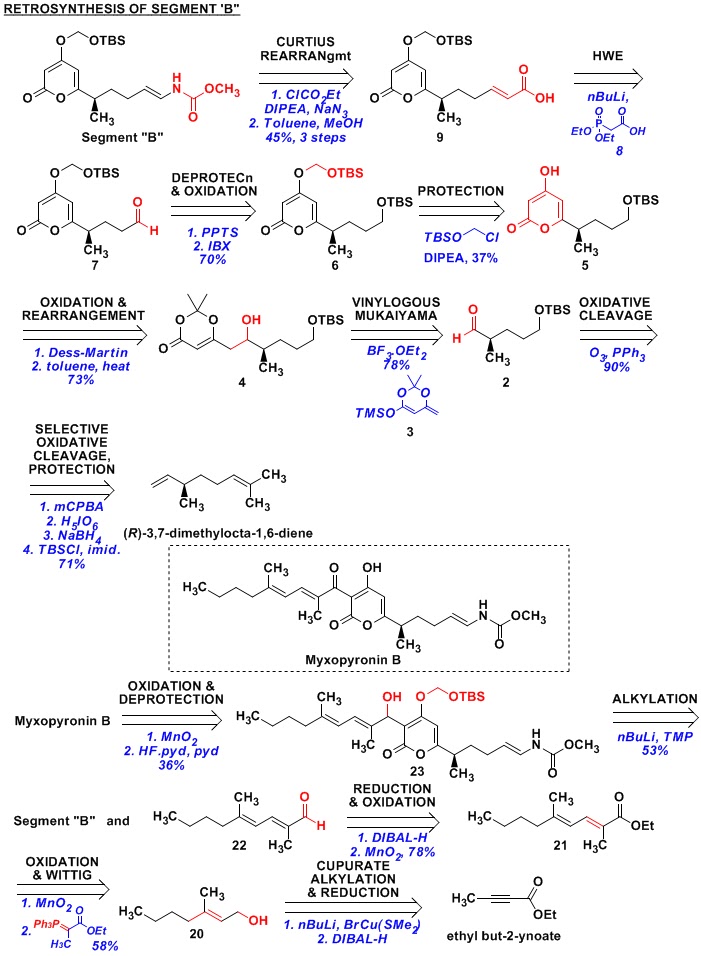
 The retrosynthesis of corallopyronin begins with removal of protecting groups (OTBS, and OCH2OTBS) and oxidation of the alcohol in 19 to the corresponding ketone.  The OCH2OTBS group is called tert-butyldimethylsiloxylmethyl group or SOM and was used for differentiating two hydroxyl groups earlier in the synthesis.  Secondary alcohol 19 is prepared by connecting fragments “A” and “B” by an alkylation reaction that used LiTMP as the base. 

Fragment “A” has a terminal conjugated aldehyde on the right-hand-side that is installed by reduction of the corresponding ester to the alcohol followed by oxidation to the aldehyde.  The left-hand-side of fragment “A” has a terminal propene that is formed by reacting acetaldehyde with the sulfone formed by the oxidation of intermediate 18.  Compound 18 is prepared by a Mitsunobu reaction between phenyltetrazole thiol 17 and terminal alcohol 16.  The TBS-protected secondary chiral alcohol of 16 is formed by using (-)-DIPCl as the chiral reduction agent upon ketone 15.  This reduction gave the product with 95% ee and the absolute stereochemistry was confirmed by making the corresponding Mosher’s esters.  Ketone 15 is formed by reacting zincate 12 with aldehyde 14 followed by Swern oxidation of the resulting alcohol.  Aldehyde 14 comes by a selective oxidative cleavage of the more electron-rich alkene in 13.  Finally, compound 13 is prepared from Gerinol by an oxidation and Wittig protocol.  The zincate intermediate 12 was prepared in an interesting fashion from bromo-boronate 11 by treatment with dimethylzinc.  In turn, compound 11 is prepared from bromo-alkyne 10, which I presume comes from butynol. 

Fragment “B” has a terminal vinyl carbamate group on the right-hand-side.  Since vinyl-amines are unstable, a Curtius-rearragement is used to prepare this functionality.  This gives us acid 9 as the precursor, which is prepared from aldehyde 8 by a Horner-Wadsworth-Emmons reaction of phosphonate ester 8 with aldehyde 7.  Aldehyde 7 is prepared from TBS protected alcohol 6, which came from protected alcohol 5.  Here, we see the installation of the SOM group to differentiate the terminal (TBS protected) alcohol from the hydroxyl group on the enol-form of the diketoester.  Pyrone 5 comes from the rearrangement of ketone formed by the oxidation of 4.  Compound 4 is prepared by the signature reaction of the Kalesse group – “the Vinylogous Mukaiyama Aldol Reaction” (VMAR).  Thus, the reaction of aldehyde 3 with the vinylogous-silyl-ketene-acetal 3 generates the desired product 4.  Compound 2 is prepared from beta-(-)-citronellene by (a) selective oxidative-cleavage of (R)-3,7-dimethylocta-1,6-diene; (b) reduction of the aldehyde to the alcohol; and (c) protection of the alcohol as TBS ether.

In this paper, the authors have also described the completion of the synthesis of a related natural product – Myxopyronin B.  Retrosynthetically, it involves the combination of Fragment “B” with aldehyde 22 (followed by oxidation and the removal of SOM protecting group).  Aldehyde 22 is derived from ester 21, which in turn, comes by an oxidation-Wittig sequence on alcohol 20.  Alcohol 20 is prepared by the attack of nBu-cupurate (prepared by reacting nBuLi with BrCu(SMe2)) on ethyl butynoate – an example of nBuLi being used as the reagent with the “nBu” portion getting installed on the molecule.

Overall, an excellent piece of work from the Kalesse group which includes the signature “VMAR” (i.e. Vinylogous Mukaiyama Aldol Reaction).  Other interesting features include the Curtius reaction which installs the sensitive vinylcarbamate group, SOM groups that allows for the differentiation of hydroxyl groups, selective oxidative cleavage of electron-rich alkenes in presence of electron-deficient alkenes, liberal use of easy-to-perform oxidations and reductions, use of (-)-DIPCl to establish the desired “R” configuration, using easily available chiral starting materials "geraniol" and "beta-(-)-citronellene", and finally, the use of buffered HF.pyridine in THF/pyridine to remove the silyl protecting groups.  The fact that all this was done by a single chemist makes it even more commendable!

Tuesday, January 29, 2013

Helioporin C


Helioporin C
Organic Letters 2012, 14, 5996
W. Lorsberg, S. Werle, J.-M. Neudorlf, H.-G. Schmalz*

The retrosynthesis of helioporin C begins with oxidation of the allylic hydroxyl group in 15 thus generating the sensitive a,b-unsaturated ketone in the last step.  These conjugated unsaturated species are very reactive and can sometime lead to unnecessary side reactions and it is wise to leave their formation towards the end.  The hydroxyl group of 15 was formed by the addition of the vinylic Grignard reagent 14 on aldehyde 13.  The aldehyde functionality was formed by a TBS deprotection followed by oxidative cleavage of the diol by using periodic acid from 12.  The chiral methyl group on 12 was installed by a stereoselective reduction of alkene 11 by a hydrogenation procedure that used an Iridium-based chiral catalyst developed by Pfaltz.  Alkene 11 came by an ene-reaction between alkene 9 and TBS-protected glycolaldehyde using dimethylaluminum chloride.  Compound 9 was prepared by a Friedel-Crafts-type cyclization procedure on 8, again using dimethylaluminum chloride as the catalyst.  These two steps are really interesting as they use the same reagent!  But, more importantly, the relative geometry (syn) is established in this step with moderate selectivity (4:1).  Compound 9 was not separable from its diastereoisomer and was therefore carried on into the next step where the undesired isomer was separable.  Compound 8 was prepared by an alkyl-Suzuki-reaction (not often seen!) between 9-BBN-derivative of alkene 6 and vinyl iodide 7.  The hydroboration protocol is well established and so this is a reliable disconnection strategy.  Alkene 6 was prepared in extremely high yields and selectivity by a stereoselective methylation/elimination procedure that used a chiral catalyst derived from (S,S-TADDOL) and used the cuparate as the attacking species.  Chloride 5 was installed by a unique oxidative chlorination step, which I had never seen before, from allylic alcohol 4.  Alcohol 4 was prepared by a nucleophilic attack by aryl-lithium derived from bromide 3, which in turn was prepared from dimethoxy compound 2.  The bromo-group on 2 was installed by brominating commercially available 1,2-dimethoxy-3-methylbenzene.
There are three chiral centers in this molecule and two of these were installed by using chiral-catalysts.  Both of these steps gave the product in very high selectivities and that is a take-home message from this synthesis. Finally, they have also prepared Helioporin E, from intermediate 15 by using methanesulfonic acid at very low temperatures (not drawn).

Wednesday, January 16, 2013

(-)-Aurafuron A


(-)-Aurafuron A
Organic Letters 2012, 14, 3064
O. Hartmann & M. Kalesse*
The retrosynthesis of (-)-aurafuron A begins with the disconnection of the furanone ring into mono-dithane-β-diketone moiety followed by deprotections of the TBS ethers.  The formation of the furanone ring proved to be troublesome as several reagents failed to give the desired product.  The goal is to enolize the carbonyl group in 14 and then make it attack at the dithiane carbon (after hydrolysis or with simultaneous hydrolysis).  Synthetically, methyl iodide with CaCO3 in acetone gave the desired product, which was then followed by the removal of the TBS ethers by using HF.pyridine in THF/pyridine*.  Compound 14 was prepared by an aldol reaction between diethiane ketone 13 and the aldehyde 12 with lithium bistrimethylsilylamide employed as the base.  Compound 12 was prepared by a Suzuki reaction between vinly iodide 5 and boronate ester 11.  Boronate ester 11 was formed by a cross-metathesis reaction between vinyl boronate ester 10 and alkene 9.  The original strategy of the authors was to perform a Heck reaction between alkene 9 and vinyl iodide 5 to prepare 12.  When it failed, the present route was used instead.  This sort of thing happens quite frequently and it is really crucial to be able to make adjustments to the original plan.  In this regard, the terminal alkene is quite versatile intermediate as it can be easily transformed into a vinyl iodide or a boronate ester.  Moving further back, compound 9 was formed by the reaction of “butane anion” on aldehyde 7 by using a chiral borate.  This reaction gave the trans product exclusively.  Aldehyde 7 was prepared by another aldol condensation between propanal and 3-methylbutanal.  Vinyl iodide 5 was prepared by the selective deprotection of the primary TBS ether in 4 while keeping the secondary TBS ether intact.  This was achieved by using PPTS in methanol and was then followed by the syn reduction of the alkyne.  Compound 4 was prepared by TBS protection of the secondary alcohol in 3 followed by changing TMS group to the iodide.  Alcohol 3 came by (a) attack of TMS-acetylene on aldehyde; (b) oxidation of the racemic alcohol to the ketone; (c) stereoselective reduction of the ketone by using Noyori’s catalyst.  Aldehyde 2 was derived from butenol by protection and ozonolysis.
Overall, a neat synthesis from the Kalesse group with several noteworthy steps including tricky aldol condensations, an interesting cross-metathesis step (which incidentally has been used before in their labs), and a stereoselective establishment of the butene group.
*: Back in the year 2000, I was a postdoc with Prof. Kalesse and used HF.pyridine in THF/pyridine to deprotect two TBS ether in the final step of making ratjadone.  Ratjadone was very sensitive to even trace amounts of acids and we used extra pyridine during the TBS deprotection step.  It works really well!


Friday, January 11, 2013

(-)-Teuvcidin


(-)-Teuvcidin

Organic Letters 2012, 14, 2886

X. Liu, C.-S. Lee*


The retrosynthesis of (-)-teuvcidin beings with the addition of the furan-3-yllithium on the aldehyde group produced by oxonolysis of 14.  The addition of furan-3-yllithum to the aldehyde produces the corresponding hydroxyl anion that closes on the adjacent methyl ester to form the lactone.  Ester 14 was prepared by the oxidation of the aldehyde 13 to the corresponding acid and then esterification under neutral conditions by using diazomethane.  Diazomethane mediated esterfications are the norm in late-stage, acid- or base-sensitive molecules.  Compound 13 was derived from furan 12 by an oxidation protocol utilizing sodium salt of N-chlorobenzenesulfonamide in methanol.  This generates the dimethoxytetrahydrofuran ring initially, which get aromatized under acidic conditions to give the corresponding furan 12.  Compound 12 has an allyl substitution a to the aldehyde – which strongly points to a Claisen rearrangement as the next disconnection.  Thus, compound 12 is derived from 11 by using diisopropylethylamine in 1,2-dichlorobenzene at reflux.  Compound 11 was obtained by the O-alkylation of the enolate of aldehyde 10.  The authors tried direct  a-allylation of aldehyde 10 but failed and had to resort to an initial O-allylation followed by Claisen rearrangement.  Neat trick indeed!  Moving backwards, compound 10 was obtained from ester-epoxide 9 by using TBAF.  In the text, the authors state “Under the reaction conditions, dealkoxycarbonylation of (-)-9 generated an enolate, which underwent epoxide ring opening, acetal formation, and elimination of water to afford the fused furan moiety of (-)-10”. So, first TBAF removes the TMS-ethoxycarbonyl group first, then opens the epoxide, which attacks the carbonyl-carbon to get a hydroxyl group which gets eliminated as water.  Instead, I feel that after removal of the TMS-ethoxycarbonyl group, an enolate gets formed (from the ketone side) and it attacks the epoxide (via the O‑).  The hydroxyl group that is formed is then eliminated as water.  In any case, whatever the mechanism, this is indeed a nice way to make the furan ring.  The epoxide group in 9 is derived from alkene 8.  The synthesis of compound 8 is the key methodology of this paper – It is formed by a tandem Michael-Coria-Ene-cascade-cyclization reaction.  So, what’s happening here?  The aldehyde enolate formed on 7 by Lewis acid activation attacks in a Michael fashion on the carbon-carbon double bond; this then attack the alkyne in a 6-endo-trig fashion to form the carbocyclic ring in 8.  Compound 7, not surprisingly, was prepared by a Knoevenagle reaction of b-keto-ester 5 on aldehyde 6.  The b-keto-ester 5 was prepared by an insertion of the diazo compound 4 on acid formed from 3 by (a) removal of TIPS group; (b) oxidation of the resulting alcohol to the acid.  Here, it is quite interesting to note the selective deprotection of the TIPS ether in presence of the TES-ether by using 1-chloro-ethylchloroformate (as the source of hydrogen chloride).  This is quite neat as it was quite clean reaction.  Compound 3 was prepared from ester 2 by reduction of the ester group followed by protection as TIPS.  Finally, compound 2 was prepared by the TES protection of the primary alcohol in 1.


Overall, some interesting transformations – (a) selective deprotections of the TIPS ether in presence of TES-ether; (b) unique cyclization protocol to form the carbocyclic ring (methodology which was published earlier by their group); (c) nice way to prepare a furan ring; and (d ) a stepwise Claisen rearrangement.


Tuesday, January 8, 2013

Clavosolide A


Clavosolide A

Organic Letters 2012, 14, 5614

G. Peh and P. E. Floreancig*

The retrosynthesis of clavosolide A beings with the dimerization of the hydroxyl-acid unit 11 by using the classical Yamaguchi cyclization (trichlorobenzoyl chloride, DMAP, toluene, 65 °C).  Advanced intermediate 11 was produced from 10 in three steps – first stereoselective reduction of the ketone in the presence of Corey’s boraxazoline chiral catalyst established the “S” configuration on the hydroxyl; then the TIPS group was removed under acidic conditions, which was followed by oxidation of the free primary alcohol selectively (over the secondary alcohol) to the corresponding acid by using bleach.  Intermediate 10 was prepared by a glycosidation reaction of sugar 9 with the secondary alcohol obtained by the reduction of the ketone group of 8.  It is interesting to note that reduction of ketone 8 was stereoselective in favoring the formation of the equatorial hydroxyl group only.  Compound 8 was prepared from enol-ether 7 by using DDQ and lithium perchlorate.  This oxidative cyclization is an offshoot of methodology that has been developed in the author’s laboratories during the past few years.  Compound 7 was prepared by alkylation of alcohol 5 with mesylate 6, followed by ruthenium catalyzed O-acetylation of the acetylinic bond.  Alcohol 5 was prepared from a zinc-mediated coupling between mesylate 4 and aldehyde 3 using conditions developed by the Marshall group.  Acetylene-mesylated 6 was prepared by Negeshi propargylation procedure on ketone 2, which in turn was prepared cyclopropanation of chloro-alkene 1.  This cyclopropanation procedure gives trans products selectively and proceeds via a conjugate addition step followed by enolate trapping.  (See JACS, 2010, 132, 14349). EXTRA: compound 1 was prepared by reacting allyl chloride with acetyl chloride!

Thus, in this synthesis, the cyclopropanation step was performed right in the beginning and all subsequent transformations kept the ring intact.  Also interesting was the oxidative cyclization step to prepare the pyran ring (7 to 8). 

Wednesday, December 26, 2012

Voacangalactone


Voacangalactone

Organic Letters 2012, 14, 5800

M. Harada, K. N. Asaba, M. Iwai, N. Kogure, M. Kitajima, and H. Takayama*

The retrosynthesis of Voacangalactone A begins with the reduction of keto-amide group in 17 to reveal the amine functionality.  Compound 17 was prepared by cyclization of the keto-ester on the deprotected amine, which in turn came by acylation of oxalyl chloride on indole 16.  The indole ring was closed by using Utimoto’s protocol employing NaAuCl4.2H2O as the oxidant on alkyne 15, which was prepared by a Sonogashira reaction between 2-iodo-4-methoxyaniline and alkyne 14.  Here, CuSO4 was used as the copper source – no doubt reduced to Cu(I) by Na-ascorbate.  I had never seen being used in Sonogashira reaction, but this is referenced from the work of Bag, S. S. et al. Org. Chem. 2011, 76, 2332–2337.  Going further back, the alkyne 14 was prepared from alcohol 13 using standard transformations.  Compound 13’s precursor was iodo-alcohol 12, which came from acid 11.  Acid 11 was prepared by an iodo-lactonization-hydrolysis sequence on diester 10.  This is a really nice step as it establishes the lactone-ring elegantly and also allows differentiation of the oxidation states of the pendant carbon.  The bicyclic-amine 10 was closed by alkylating Cbz-amine 9.  Compound 9 is a penta-substituted cyclohexene and thus it is not surprising that an asymmetric Diels-Alder reaction was used to prepare it.  Its immediate precursor is the chiral auxiallary containing intermediate 8, which comes by a Diels-Alder reaction between dimethyl 2-methylenemalonate and diene 7.  This Diels-Alder reaction is between an electron-rich diene and an electron-deficient dienophile.  No wonder, it even goes at room temperature.  It is also completely regioselective – again due to the relative electronics of the reactants.  The absolute stereochemistry is driven by the chiral auxiallary.  This is the key step of this synthesis.  The diene was prepared by a Cu-mediated amination of vinyl-iodide 5.  Adjustment of the carbon oxidation states meant that 5 came from conjugated ester 4, which came from aldehyde 3 by a Wittig reaction.  Aldehyde 3 was prepared by reduction-oxidation sequence on acid 2, which was prepared by decarboxylation/hydrolysis of diester 1.  Diester 1 was prepared by alkylation of diethyl ethylmalonate.


Overall, a really nice synthesis.


Tuesday, December 18, 2012

Alotaketal A


Alotaketal A
Organic Letters 2012, 14, 5492-5494
M. Xuan, I. Paterson, S. M. Dalby *
The retrosyntheses of Alotaketal A begins with a sequence of double oxidation of two alcohols (a primary and the other secondary) and then selective reduction of the aldehyde in presence of the ketone by using sodium triacetoxyborohydride.  This is a bold final step!  Compound 16 has the sensitive ketal group which is formed by internal cyclization and protection of compound 15.  The allylic alcohol in 15 is formed by the nucleophilic attack of lithiated 6 on lactone 14.  Lactone 14 is formed by an intermolecular HWE reaction of phosphonate 13, which comes by the coupling of acid chloride of 12 with alcohol 11.  Here, the Yamaguchi reagent (trichlorobenzoyl chloride) was used to activate the acid.  Compound 11 was prepared by the selective Johnson-Lemieux oxidation of the less-hindered alkene bond of compound 10.  Compound 10 was derived by an interesting allylic oxidation and then selective reduction procedure.  The allylic alcohol 9 gets oxidized to the ketone (at the unsaturated carbon) with simultaneous dehydration to give an a,b-unsaturated ketone (not drawn).  This is then stereoselectively reduced to the allylic alcohol 10 by using the bulky L-selectride.  The protected TBS ether in 9 came from by the reduction (and then protection) of ketone 8.  This a-hydroxyketone was prepared by Rubbotom oxidation of ketone 7 (7 was first converted to its TMS enol ether and then oxidized by using mCPBA).  Compound 7 was prepared from (R)-carvone by first chlorinating the allylic carbon (Ca(OCl)2), then hydrolyzing it to the alcohol and then protecting it as TIPS-ether.
The intermediate 6 has the allylic iodide group, which came from the corresponding ester 5.  Ester 5 was treated with TMSCH2MgCl which gave the double addition of the “CH2-“ group on the ester.  It also produced a tertiary alcohol which eliminated.  Ester 5 came from a Nagao aldol reaction of chiral auxially 3 with aldehyde 2.  Aldehyde 2 is simply the oxidized form of geraniol – but it was produced in a rather round-about way.  Geraniol was first chlorinated and then reduced by LAH.  The allyl group was then oxidized to the aldehyde by MnO2.
 

Wednesday, December 12, 2012

Aspercyclides A & B


Aspercyclides A  & B

Organic Letters 2012, 14, 4290-4292

T. Yoshino, I. Sato*, M. Hirama

The retrosyntheses of Aspercyclides A and B begin with a common advanced intermediate 8.  For aspercyclide A (which has an aldehyde group), the hydromethyl in 8 is first oxidized using manganese oxide and the benzylether is deprotected using boron trichloride.  For aspercyclide B (which has the hydroxymethyl group), the benzylether group is deprotected using boron trichloride.  Thus, with one advanced intermediate, they are able to get two natural products.  Intermediate 8 is prepared by a very interesting selective oxidative phenol-aryl bonding.  There are two phenolic groups present in 7 (the precursor to 8) and only one of them is oxidized and undergoes a ring-closure reaction with the other aryl ring.  The authors explain this chemo-selectivity on the relative electron richness of the two phenols.  One has alkyl substituents, while the other has a carbonyl group on it – the more electron rich phenol (with alkyl substituents) gets oxidized and reacts with the other.  They even did a side experiment where they took two phenols – one with alkyl groups and the other with carbonyl.  Only the one with the alkyl groups reacts with phenyl iodoacetate!  Very nice!! Moving along backwards, intermediate 7 comes by a slightly convoluted protection/deprotection series of steps, but it again has some interesting selectivity.  Intermediate 7 has the hydroxymethyl group protected as the TBS ether and with two open phenol groups.  All three were initially protected as TBS ether, but the two phenol hydroxyl groups were deprotected selectively by TBAF (i.e. TBAF left the hydroxymethyl TBS ether intact!)  Their precursor was formed by the acetonide deprotection of 6.  Intermediate 6 comes by esterification reaction between alcohol 4 and methyl ester 5.  Compound 4 was derived from a Heck reaction between alkene 3 and aryl iodide 2.  Alkene 3 was prepared by attack of butyl anion (from nBuLi) on epoxide formed by the Sharpless epoxidation (and the benzyl ether protection) on penta-1,4-dien-3-ol.  Also interesting are the preparation of intermediates 5 and 2 from a common precursor – 1.  Thus compound 5 is prepared by palladium catalyzed methyl zinc  substitution on iodide 1, whereas compound 2 is prepared by deprotection of the acetonide in 1, followed by reduction of the acid to the alcohol and the re-formation of the acetonide ring. 

Overall, this is a very neat synthesis and has some very interesting selective transformations (selective TBS ether deprotection & selective phenolic oxidative cyclization).  


Tuesday, November 27, 2012

Aldingenin


Aldingenin

Organic Letters 2012, 14, 2168

M. T. Crimmings*, C. O. Hughes

The retrosynthesis of aldingenin begins with the deprotection of the benzyl ether and the bromoetherification of compound 13.  The bromoetherification step using 2,4,4,6-tetrabromocyclohexa-2,5-dienone (TBCO) also gave the 5-exo product (i.e. produced bromotetrahydrofuran ring) which reduced the overall yield.  The tertiary hydroxyl group in 13 was prepared by the addition of “Me-” to ketone 12 by using MeLi along with CeCl3.LiCl.  Here the attacking reagent is presumably the less nucleophilic “MeCeCl2” with additional coordination with LiCl.   When isopropylidiene phosphorane was used on aldehyde 10, the prenyl product 12 could not be prepared. So, the prenyl group in 12 was prepared by a cross-metathesis reaction between alkene 11 and 2-methyl-2-butene (also served as the solvent!).  This is a really neat trick because alkene 11 was prepared from aldehyde 10 by using a variation of “Wittig-reaction” – Nysted conditions (Zn3Br2(CH2)2, BF3.OEt2, THF).  Again, this was necessitated by the failure of traditional Wittig and Tebbe reagents in this step, which I suspect might be due to the presence of a keto group in addition to the aldehyde.  Keto-aldehyde 10 was prepared by a double Swern oxidation step of alcohol 9, which, in turn was prepared from compound 8.  In this step, the cyclopentadienyl ketal got hydrolyzed to reveal the diol which immediately cyclized with the internal ketone group.  Compound 8 is an alpha-hydroxy ketone, and is formed by the nucleophilic attack of dithiane 7’ on aldehyde 7.  This is the classic “umpulong” chemistry and it required the presence of CeCl3.LiCl along with the base (nBuLi).  The Crimmins group also came up with a method to dry CeCl3 – which was crucial in this step.  The aldehyde group in 7 came by the Ley oxidation of alcohol 6, which was prepared from diol 5.  syn-Diol 5 was prepared by a hydroxyl-directed stereoselective dihydroxylation step employing OsO4 along with TMEDA – which is quite noteworthy.  Alkene 4 is ripe for a RCM disconnection to reveal bis-alkene 3, which came from the removal of the chiral auxiliary from 2. Compound 2 was prepared by a “anti-selective-aldol” reaction between dibenzyl acetal 1’ and the chiral thiazolidinone 1.

Unfortunately, at the end of the synthesis the spectra of the natural and the synthetic material did not match! That’s not what you want to see at the end of the synthesis – but a great job by the synthetic chemist nevertheless – after all this was the structure they proposed!  So, the structure of the naturally isolated material needs to be elucidated correctly. 

Tuesday, November 20, 2012

Isonitramine


Isonitramine

Organic Letters 2012, 14, 852

Y. Park, Y. J. Lee, S. Hong, M. Lee, H. Park*

The retrosynthesis of isonitramine begins with the unmasking of the amine (from the amide) and the alcohol (from the ketone).  The diphenylmethyl protection on amine 11 was removed by hydrogenation and amide 10 was reduced by lithium aluminum hydride reduction.  Amide 10 was prepared by the stereoselective reduction of the ketone group in 9 by Dibal-H.  The Al coordinates on the side containing the amide oxygen while delivering the hydride ion, thus giving the R configuration on secondary alcohol in 10.  Ketone 9 was derived by decarboxylation of ketoester 8, which is the Robinson annulation product of diester 7.  At this stage, there is a protecting group interchange in 6.  Compound 6 is derived by xanthate group removal from 5, which in turn is coming from the radical addition of xanthate and “ethylacetate anion” across the carbon-carbon double bond in 4.  Compound 4 is prepared from bromide 3 (because the non-brominated version did not give high ee).  The synthesis of compound 3 is what drives this synthesis – the “phase transfer catalyst” driven asymmetric allylation of alpha-tertbutoxycarbonyllactam compound 2.  A chiral PTC is used which gives the product is highly stereoselective fashion, but it required the 2-bromoallyl bromide instead of allyl bromide.  This is an example of the utility of “Br” as a masked “H” to improve stereoselectivity.  Compound 2 is prepared by installing the butoxycarbonyl group on valerolactam.

I noticed that all but 2 steps had >90% yield (and those two were also >85%)!!  Although most steps are fairly standard, but I still find it very impressive – especially when considering the messy “tin chemistry” and the final two reduction steps.  


Tuesday, November 13, 2012

Ripostatin B


Ripostatin B

Angew. Chem. Int. Ed. 2012, 51, 3396

P. Winter, W. Hiller, & M. Christmann*

The retrosynthesis of Ripostatin B begins with a deprotection of the protected secondary hydroxyl groups and the oxidation of the primary alcohol group to the acid.  It is interesting to note that the two secondary hydroxyl groups were differently protected – one as a TBS group and the other as an ester group.  It is rather unusual to see the final stage deprotection using LiBEt3, but worked in this case quite selectively, without harming the conjugated lactone functionality.  The isolated double bond in 14 was installed by a RCM reaction using Grela’s catalyst on substrate 13.  The allyl group was installed by a Stille coupling on vinyl iodide 12, which in turn was derived from a Yamaguchi esterification of acid 11 with alcohol 10.  The alcohol group in 10 was derived by an Evans-Tischchenko reduction of the ketone, which was present as it dithiane derivative in 9.  The preparation of compound 9 was the showcase event in this total synthesis – the coupling of a silylated dithane with two different epoxides – and this required some optimization with regards to the order of addition (i.e. after anion formation, epoxide 4 was added followed by epoxide 7).  It is also important to note that this step gave mono-protected TBS ether.  The other elegant strategy was the preparation of both epoxides 4 and 7 from geranyl acetate.  Epoxide 7 was derived from aldehyde 6 (stereselective epoxide formation with the increase of one carbon atom via a Corey-Chaykovsky procedure followed by Jacobsen resolution), which came from epoxide 5 by sodium periodate mediated oxidative cleavage.  Epoxide 5 was derived a lithium cupurate addition on geranyl acetate.  In contrast epoxide 4 (which has the same carbon count at geranyl acetate), came by an internal attack of the hydroxide on a chiral “Cl” atom – which was installed in stereospecific manner by using the Jorgensen/MacMillan protocol.  The terminal hydroxyl group came from the reduction of aldehyde 3 which was prepared as before from epoxide 2 (sodium periodate oxidation).  Epoxide 2 was prepared by vinyl Grignard substitution on geranyl acetate. 

So, overall a very nice semi-convergent synthesis with some interesting transformations by the group of my former colleague, Mathias Christmann.

Wednesday, November 7, 2012

Ripostatin A


Ripostatin A

Org. Letters 2012, 14, 4690

W. Tang & E. V. Prusov*

The retrosynthesis of Ripostatin A begins with a deprotection of the protected methyl acetal which quite sensitive.  This was achieved by a mild neutral aqueous hydrolysis.  The terminal acid functionality was derived from oxidation of the primary alcohol by Dess-Martin periodinane oxidation followed by Pinnick Oxidation (sodium perchlorate).  The alcohol was originally in its TBS-protected form in 8.  Predictably, the central alkene group in 8 was formed by a ring-closing-metathesis reaction using Grubb’s second generation catalyst. The double allyl groups required for the RCM reaction were neatly installed by a double Stille reaction between allyl stannane 5 and double-vinyl-iodide compound 6.  Conceptually, this is really interesting as it reduces the need to install the two carbon-carbon-double-bond groups separately.  The ester group of compound 6 is the next disconnection giving rise to acid 5 and alcohol 4.  The ketal group of 4 comes from the open ketone 3, which is prepared by an Patterson Aldol reaction between methyl ketone 2 and aldehyde 1.  The syntheses of both 1 and 2 have been described by the authors in their previous publication Angew. Chem. Int. Ed. 2012, 51, 3401–3404.


Tuesday, October 30, 2012

(-)-Huperzine A


(-)-Huperzine A

Organic Letters, 2012, 14, 4446-4449

R. Ding, B.-F. Sun, G.-Q. Lin

The retrosynthesis of (-)-Huperzine begins with an acid-mediated rearrangement along with dehydration to install the two double bonds.  The conditions for these two transformations took a while to develop as there were other side-reactions occurring as well.  The rearrangement is especially noteworthy since it allows the use of (R)-pugelone as the starting material.  The tertiary alcohol in 10 is formed by ethyl Grignard addition to the ketone 9, which in turn comes by oxidation of diastereomeric alcohols 8.  An elegant Heck-reaction forms the bicyclic structure from 7.  This shows the two parts of the molecule – the “cyclohexene” and the “pyridine” parts – linked through a methylene group.  Thus, alcohol 7 comes by reduction of ketone 6, which is setup to be derived by an enolate addition of ketone 4 on bromide 5.  Compound 4 is derived by a Buchwald-type coupling of Boc amine on enol triflate 3.  The enol triflate 3 is derived from 2, which is easily accessible from (R)-pulegone.

(-)-KAITOCEPHALIN


(-)-KAITOCEPHALIN

Organic Letters, 2012, 14, 1644-1647

K. Takahashi, D. Yamaguchi, J. Ishihara, S. Hatakeyama*


The retrosythesis of (-)-Kaitocephalin begins with unmasking all the acid groups by oxidizing phenyl and carbon-carbon double bonds while the amino and alcohol groups are also simultaneously generated by deprotecting the oxazolidone ring of 14.  This is very rarely seen in total syntheses as people generally shy away from such strong oxidations towards the end of the synthesis.  So, keeping a benzene ring and carbon-carbon double bonds are “masked acids” is a useful disconnection.  Compound 14 predictably comes from acid chloride 13 and deprotected form of amine 12.  Compound 12 is formed by a stereoselective intramolecular C-H amination in 11 mediated by a Rh catalyst.   This is a neat way of establishing a crucial stereocenter.  Compound 11 comes from protected alcohol 10.  Compound 10 is generated by an intramolecular addition of a carbamate on cyclic sulfamate 9, which comes from another stereoselective intramolecular C-H amination of sulfonamide 8.  This step is very similar to the preparation of 12 from 11 – sulfonyl versus and carbonyl and also a different ligand is used in the Rh catalyst.  Compound 8 comes from protected alcohol 7, which in turn is prepared by a Overman rearrangement reaction of alcohol 6.  This step establishes the quaternary spiro stereocenter.  Compound 6 is formed by a Suzuki reaction between alkyl boronate ester and vinyl iodide 5.  This comes from protection-deprotection of alcohol 4 whose precursor is ketone 3.  Ketone 3 comes from the iodination of 2, which is derived from alcohol 1, by an enzyme-mediated stereoselective oxidation.


(-)-205B


(-)-205B

J. Am.  Chem. Soc., 2012, 134, 15237

D. Yang & G. C. Micalizio*


The retrosynthesis of (-)-205B, an azatricyclododecene isolated from Dendrobates pumilio, begins with deoxygenation and rearrangement of the double bond of compound 10, which in turn is derived from alcohol 9.  Alcohol 9 is formed by an aza-Sakurai reaction/ring-opening sequence from bicyclic compound 8.  Alkene 8 is derived from ester 7 by a reduction and deoxygenation procedure  Compound 7 comes by a reduction and Horner-Wadsworth-Emmons reaction of reagent 6 with ester 5.  Bicyclic compound 5 is derived from a intra-molecular [2+3] cycloaddition reaction involving the iminium ion formed by the addition of butylglyoxolate with amine-oxide 4.  Compound 4 is formed by oxidation of amine 3, which in turn is derived from a reductive cross-coupling between silane 2 and aldehyde 1.  Overall, the retrosynthesis is derived from two methodologies developed in the Micalizio lab – (a) Ti-mediated reductive cross-coupling between an aldehyde and an allylic alcohol (compound 3 from 1); and (b) intramolecular [3+2] cyclization of a glyoxalate-based homoallylic nitrone (compound 5 from 4).